
The Hidden Work Behind Successful Content Marketing

Content marketing and social media management look simple from the outside. A few posts per week. A newsletter. Maybe a campaign launch every quarter. But for business owners, the reality is far more complex.
Behind every consistent content presence sits a web of planning, approvals, asset management, scheduling, tracking, and cross-team coordination. And as a company grows, that invisible workload multiplies.
The Short Version
Growing businesses struggle with content not because they lack ideas, but because they underestimate the operational load required to execute consistently. Administrative friction — approvals, file organization, revisions, platform logistics — creates bottlenecks that slow output and stall growth.
When workflows are structured and supported properly, content becomes an engine. When they aren’t, it becomes a drain.
Professional virtual support can turn scattered activity into a repeatable system — freeing business owners to focus on strategy instead of chasing tasks.
The Real Problem: Content Is a System, Not a Post
Most business owners start content marketing informally. They post when they can. They approve graphics in text threads. They track campaigns in spreadsheets. It works — until it doesn’t.
As momentum builds, the hidden tasks pile up:
● Draft creation and revisions
● Asset collection (images, video, PDFs, captions)
● Internal approvals
● Scheduling across multiple platforms
● Email coordination
● Campaign calendar management
● Analytics tracking
● Cross-functional alignment
Each task is small. Together, they form a complex operational system.
And systems break under pressure when they aren’t designed intentionally.
Where Bottlenecks Actually Happen
Many owners assume the bottleneck is “not enough time to create content.” In reality, it’s usually one of these:
Unclear approval chains – Content sits waiting for feedback.
Scattered file storage – No one can find the latest version.
Last-minute scheduling – Campaigns feel rushed.
Platform overload – Managing multiple channels manually.
Role confusion – Everyone contributes, but no one owns execution.
These friction points don’t just slow publishing. They reduce consistency — and consistency drives visibility, engagement, and revenue.
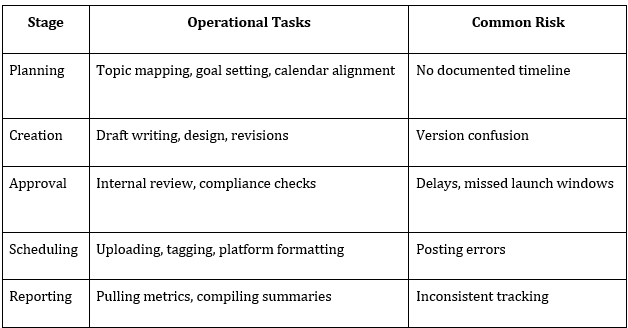
Each stage requires coordination. Multiply this by multiple campaigns per month and the administrative burden becomes clear.
How to Identify Workflow Weaknesses
If content feels chaotic, run through this quick operational checklist:
Content Workflow Health Check
● Do you have a documented content calendar?
● Is there a single location for assets and drafts?
● Are approval roles clearly assigned?
● Is scheduling handled at least one week in advance?
● Are campaign metrics reviewed on a recurring schedule?
● Does someone “own” follow-through from idea to publication?
If more than two answers are “no,” your bottleneck isn’t creativity — it’s operations.
A Structured Approach to Content Execution
Strong content systems follow a simple structure:
Problem → System → Result
● Problem: Content execution depends on the business owner’s availability.
● System: Tasks are documented, delegated, and tracked.
● Result: Publishing becomes predictable and scalable.
This is where operational support becomes strategic.
Turning Chaos Into Coordination
Partnering with EC Virtual Services gives growing businesses the operational backbone they often lack. Instead of juggling drafts, approvals, and scheduling logistics internally, business owners gain structured support for content organization, calendar management, workflow coordination, and administrative follow-through. Campaign timelines become clearer, tasks move forward without constant oversight, and social media execution remains consistent. With operational details handled systematically, leaders can redirect their attention toward growth strategy, partnerships, and long-term planning rather than chasing deadlines.
A Practical Resource for Asset Management
One overlooked operational friction point? File size and formatting issues. Large PDFs, media kits, and campaign assets often slow approvals and sharing. A simple tool like Adobe’s online feature to reduce PDF file size can streamline collaboration, especially when distributing content assets to partners or clients. Small workflow efficiencies like this compound over time.
Frequently Asked Questions
Why does content feel harder as my business grows?
Because growth increases coordination complexity. More stakeholders, more platforms, and more campaigns mean more moving parts.
Can’t software solve this?
Tools help, but tools don’t manage accountability. Someone still needs to organize, coordinate, and execute.
When should I consider virtual support?
When content delays start affecting consistency, launch timelines slip, or leadership time is consumed by follow-up tasks.
Is this just for large businesses?
No. In fact, small and mid-sized businesses benefit most because operational gaps impact them faster.
The Cost of Ignoring Operations
Inconsistent posting reduces audience trust. Missed campaigns affect revenue. Disorganized assets waste time. These aren’t creative problems — they’re structural ones.
Content marketing works best when it runs like a managed system, not a side project.
Successful content marketing is operationally demanding, even when it looks effortless online. As businesses grow, administrative complexity quietly expands — and without structure, bottlenecks follow. By strengthening workflows and leveraging professional support, business owners can turn content from a source of stress into a scalable growth asset.