
This Is Why Doing Less on Social Media Can Help You Do Better
Many businesses approach social media as if success depends on doing more—more posts, more platforms, more content styles. But spreading efforts too thin often creates chaos instead of consistency. The real secret to sustainable social media impact isn’t volume; it’s focus.
Key Takeaways at a Glance
● Businesses often struggle on social media because they attempt to master every channel at once.
● Simplifying to one or two formats reduces overwhelm and boosts consistency.
● Focused strategies build stronger brand recognition and deeper audience trust.
● Consistency across fewer platforms improves algorithmic performance and engagement rates.
● Narrowing your content types helps teams sustain creativity over time.
The Paradox of “More”
Most marketing teams assume that expanding across every social network will multiply exposure. In practice, this approach fractures creative energy.
Each channel requires a distinct tone, content style, and engagement rhythm. Juggling them all leads to burnout and brand dilution. Overextension causes missed posting schedules, uneven messaging, and scattered analytics that make it hard to measure what’s actually working. When everything is a priority, nothing truly is.
Common Overload Triggers
Below are some of the most common reasons businesses overextend.
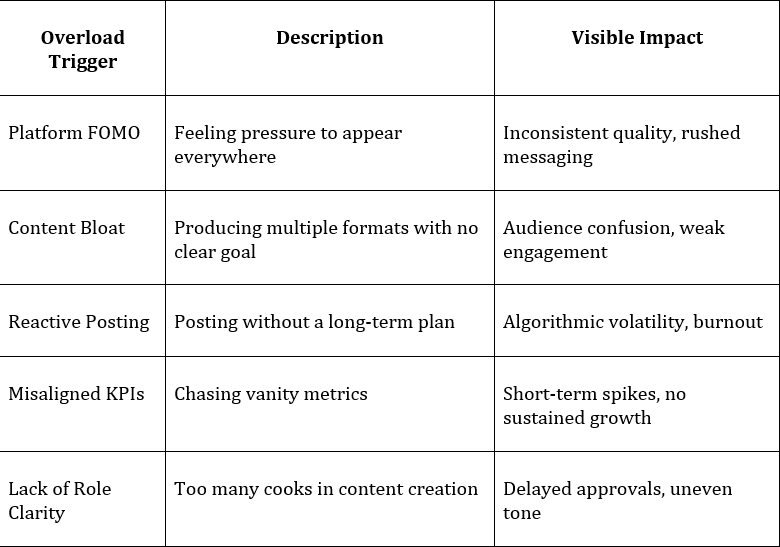
When businesses recognize these triggers, they can begin replacing quantity with strategy.
Simplify to Amplify
Focusing on just one or two core content types (short-form video and carousel posts) gives your team breathing room. It allows creators to refine tone, test consistently, and make decisions based on data instead of instinct.
Before trimming your efforts, assess which formats genuinely resonate with your audience. If your analytics show video consistently drives the most engagement, build around that strength. Let go of platforms that don’t align with your core goals.
A Quick How-To Checklist for Simplified Strategy
If you’re ready to narrow your focus, use this streamlined checklist:
Identify Your Top Two Platforms — Choose the spaces where your audience actually spends time.
Select Two Core Formats — For example, video tutorials and client testimonials.
Set a Consistent Cadence — Weekly posting beats sporadic bursts of activity.
Automate Repetition — Use scheduling tools to handle recurring posts.
Measure One Primary Metric — Engagement rate or conversion, not both.
Review Monthly — Drop what’s underperforming; double down on what drives results.
By limiting scope, you reclaim creative control and operational clarity.
Testing Visual Concepts Before Going All In
Experimentation doesn’t have to mean chaos. Businesses can preview and refine creative directions by testing multiple design ideas before a full rollout. Tools like the AI art generator from Adobe Firefly let teams generate visual variations quickly—exploring color palettes, styles, and concepts without the cost of full production. Comparing these prototypes side by side helps marketers identify which themes connect emotionally with audiences before committing to a full campaign. The result: smarter investment in content that’s visually coherent, not experimental noise.
Strategy First, Trends Second
It’s easy to feel pressure to chase every trending topic or feature release. Yet the most effective social media operations are grounded in repeatable systems, not fleeting trends. That’s where focused strategy and clear planning help brands stay consistent.
EC Virtual Services exemplifies this principle by helping businesses simplify their digital presence. Their approach begins with strategic alignment—matching goals to platform strengths and creating sustainable posting systems. Instead of encouraging brands to be everywhere, they emphasize being intentional about where and how content appears.
The Long-Term Advantage of Focus
When teams stick with fewer, well-chosen formats, they build recognizability. Audiences learn what to expect; algorithms learn who to show the content to. Over time, this compounding familiarity boosts engagement far more than sporadic bursts of trend-hopping ever could.
The shift from doing more to doing better is both strategic and psychological—it redefines success from “being everywhere” to “being remembered.”
FAQ: The Sustainable Social Media Playbook
Below are common questions from teams aiming to simplify without losing momentum.
Will narrowing focus reduce my reach?
Not if you focus on the right channels. Concentrated effort improves engagement and quality, which often expands reach organically over time.What if stakeholders demand presence on every platform?
Use analytics to demonstrate where engagement actually converts. It’s easier to defend focus when you have clear performance evidence.How often should we reassess our platform mix?
Every quarter. Consumer behavior and algorithms evolve; strategic clarity should, too.How do we maintain creativity with fewer formats?
Limiting types doesn’t mean limiting imagination—within one format, you can vary tone, story, or perspective endlessly.Can automation replace human creativity?
Automation supports consistency, but creativity still sets direction. Use tools to handle volume, not vision.What’s the first sign of overextension?
When your posting schedule drives anxiety instead of excitement, it’s time to simplify.
In Closing
Social media visibility isn’t a race to publish more—it’s a discipline of doing less, but doing it with precision. Narrowing focus helps businesses reclaim time, sustain creativity, and build strategies that last longer than the latest trend cycle.
The most effective social presence doesn’t shout everywhere at once—it speaks clearly, consistently, and with purpose.